 Add to Chrome
 Add to Firefox
 Add to Edge
Annotator Positionality as Signal: Psychometric Weighting for Anti-Autistic Ableism Detection
May 26, 2026
Large language models (LLMs) are increasingly used in decision-making tasks where they can amplify or suppress perspectives, raising concerns in high-stakes settings affecting autistic communities. While previous research has identified disability-related biases in LLMs, it remains unclear how they conceptualize ableism or detect it in text. We introduce a bias-aware evaluation framework targeting anti-autistic ableist language with a psychometrically-weighted, community-proximate ground truth anchored in annotator positionality. This framework constitutes a stricter standard than conventional majority-vote aggregation which significantly and consistently underweights autistic and autism-accepting perspectives. We find that LLMs frequently produce harmful outputs, mislabel community-reclaimed language as ableist, and express more negative attitudes toward autistic people when assessment instruments are masked. Our error analysis reveals that models rely on surface-level keyword matching rather than contextual factors such as speaker identity, and whether the language fosters in-group solidarity or inflicts out-group harm.

Text Analytics Evaluation Framework: A Case Study on LLMs and Social Media
May 20, 2026LLMs have demonstrated exceptional proficiency in a wide range of NLP tasks. However, a notable gap remains in practical data analysis scenarios, particularly when LLMs are required to process long sequences of unstructured documents, such as news feeds or, as specifically addressed in this paper, social media posts. To empirically assess the effectiveness of LLMs in this setting, we introduce a question-based evaluation framework comprising 470 manually curated questions designed to evaluate LLMs' semantic understanding and reasoning abilities over aggregated text data. We apply our benchmark on diverse Twitter datasets covering various NLP tasks, including sentiment analysis, hate speech detection, and emotion recognition. Our results reveal that the performance depends heavily on input scale and the complexity of the data sources, declining noticeably in multi-label or target-dependent scenarios. In addition, as task complexity increases, performance drops progressively from basic semantic existence identification to more demanding operations such as comparison, counting, and calculation. Furthermore, as the input size grows beyond 500 instances, we identify a common limitation across LLMs, particularly Open-weights models: performance degrades substantially, especially on numerical tasks. These findings highlight critical architectural bottlenecks in current LLMs for performing rigorous quantitative analysis over large text collections.
SemEval-2026 Task 7: Everyday Knowledge Across Diverse Languages and Cultures
May 04, 2026We present our shared task on evaluating the adaptability of LLMs and NLP systems across multiple languages and cultures. The task data consist of an extended version of our manually constructed BLEnD benchmark (Myung et al. 2024), covering more than 30 language-culture pairs, predominantly representing low-resource languages spoken across multiple continents. As the task is designed strictly for evaluation, participants were not permitted to use the data for training, fine-tuning, few-shot learning, or any other form of model modification. Our task includes two tracks: (a) Short-Answer Questions (SAQ) and (b) Multiple-Choice Questions (MCQ). Participants were required to predict labels and were allowed to submit any NLP system and adopt diverse modelling strategies, provided that the benchmark was used solely for evaluation. The task attracted more than 140 registered participants, and we received final submissions from 62 teams, along with 19 system description papers. We report the results and present an analysis of the best-performing systems and the most commonly adopted approaches. Furthermore, we discuss shared insights into open questions and challenges related to evaluation, misalignment, and methodological perspectives on model behaviour in low-resource languages and for under-represented cultures.
PingPong: A Natural Benchmark for Multi-Turn Code-Switching Dialogues
Jan 24, 2026Code-switching is a widespread practice among the world's multilingual majority, yet few benchmarks accurately reflect its complexity in everyday communication. We present PingPong, a benchmark for natural multi-party code-switching dialogues covering five language-combination variations, some of which are trilingual. Our dataset consists of human-authored conversations among 2 to 4 participants covering authentic, multi-threaded structures where replies frequently reference much earlier points in the dialogue. We demonstrate that our data is significantly more natural and structurally diverse than machine-generated alternatives, offering greater variation in message length, speaker dominance, and reply distance. Based on these dialogues, we define three downstream tasks: Question Answering, Dialogue Summarization, and Topic Classification. Evaluations of several state-of-the-art language models on PingPong reveal that performance remains limited on code-switched inputs, underscoring the urgent need for more robust NLP systems capable of addressing the intricacies of real-world multilingual discourse.
Annotating Dimensions of Social Perception in Text: The First Sentence-Level Dataset of Warmth and Competence
Jan 09, 2026Warmth (W) (often further broken down into Trust (T) and Sociability (S)) and Competence (C) are central dimensions along which people evaluate individuals and social groups (Fiske, 2018). While these constructs are well established in social psychology, they are only starting to get attention in NLP research through word-level lexicons, which do not completely capture their contextual expression in larger text units and discourse. In this work, we introduce Warmth and Competence Sentences (W&C-Sent), the first sentence-level dataset annotated for warmth and competence. The dataset includes over 1,600 English sentence--target pairs annotated along three dimensions: trust and sociability (components of warmth), and competence. The sentences in W&C-Sent are from social media and often express attitudes and opinions about specific individuals or social groups (the targets of our annotations). We describe the data collection, annotation, and quality-control procedures in detail, and evaluate a range of large language models (LLMs) on their ability to identify trust, sociability, and competence in text. W&C-Sent provides a new resource for analyzing warmth and competence in language and supports future research at the intersection of NLP and computational social science.
Insights from the ICLR Peer Review and Rebuttal Process
Nov 19, 2025Peer review is a cornerstone of scientific publishing, including at premier machine learning conferences such as ICLR. As submission volumes increase, understanding the nature and dynamics of the review process is crucial for improving its efficiency, effectiveness, and the quality of published papers. We present a large-scale analysis of the ICLR 2024 and 2025 peer review processes, focusing on before- and after-rebuttal scores and reviewer-author interactions. We examine review scores, author-reviewer engagement, temporal patterns in review submissions, and co-reviewer influence effects. Combining quantitative analyses with LLM-based categorization of review texts and rebuttal discussions, we identify common strengths and weaknesses for each rating group, as well as trends in rebuttal strategies that are most strongly associated with score changes. Our findings show that initial scores and the ratings of co-reviewers are the strongest predictors of score changes during the rebuttal, pointing to a degree of reviewer influence. Rebuttals play a valuable role in improving outcomes for borderline papers, where thoughtful author responses can meaningfully shift reviewer perspectives. More broadly, our study offers evidence-based insights to improve the peer review process, guiding authors on effective rebuttal strategies and helping the community design fairer and more efficient review processes. Our code and score changes data are available at https://github.com/papercopilot/iclr-insights.
Beyond Keywords: Evaluating Large Language Model Classification of Nuanced Ableism
May 26, 2025Large language models (LLMs) are increasingly used in decision-making tasks like r\'esum\'e screening and content moderation, giving them the power to amplify or suppress certain perspectives. While previous research has identified disability-related biases in LLMs, little is known about how they conceptualize ableism or detect it in text. We evaluate the ability of four LLMs to identify nuanced ableism directed at autistic individuals. We examine the gap between their understanding of relevant terminology and their effectiveness in recognizing ableist content in context. Our results reveal that LLMs can identify autism-related language but often miss harmful or offensive connotations. Further, we conduct a qualitative comparison of human and LLM explanations. We find that LLMs tend to rely on surface-level keyword matching, leading to context misinterpretations, in contrast to human annotators who consider context, speaker identity, and potential impact. On the other hand, both LLMs and humans agree on the annotation scheme, suggesting that a binary classification is adequate for evaluating LLM performance, which is consistent with findings from prior studies involving human annotators.
Social Good or Scientific Curiosity? Uncovering the Research Framing Behind NLP Artefacts
May 24, 2025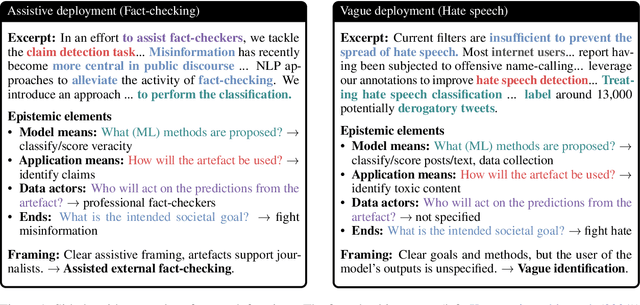
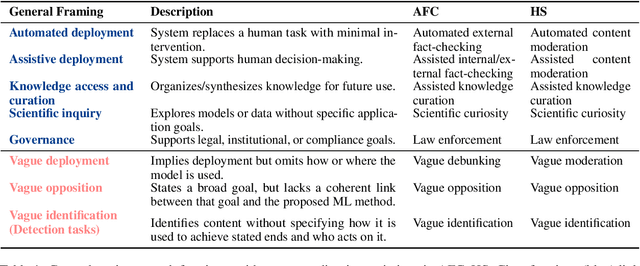
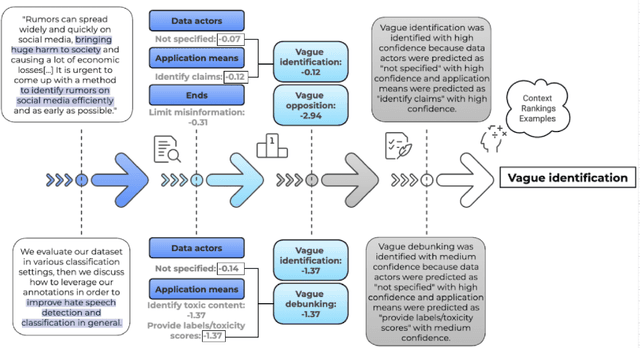

Clarifying the research framing of NLP artefacts (e.g., models, datasets, etc.) is crucial to aligning research with practical applications. Recent studies manually analyzed NLP research across domains, showing that few papers explicitly identify key stakeholders, intended uses, or appropriate contexts. In this work, we propose to automate this analysis, developing a three-component system that infers research framings by first extracting key elements (means, ends, stakeholders), then linking them through interpretable rules and contextual reasoning. We evaluate our approach on two domains: automated fact-checking using an existing dataset, and hate speech detection for which we annotate a new dataset-achieving consistent improvements over strong LLM baselines. Finally, we apply our system to recent automated fact-checking papers and uncover three notable trends: a rise in vague or underspecified research goals, increased emphasis on scientific exploration over application, and a shift toward supporting human fact-checkers rather than pursuing full automation.
SemEval-2025 Task 11: Bridging the Gap in Text-Based Emotion Detection
Mar 10, 2025We present our shared task on text-based emotion detection, covering more than 30 languages from seven distinct language families. These languages are predominantly low-resource and spoken across various continents. The data instances are multi-labeled into six emotional classes, with additional datasets in 11 languages annotated for emotion intensity. Participants were asked to predict labels in three tracks: (a) emotion labels in monolingual settings, (b) emotion intensity scores, and (c) emotion labels in cross-lingual settings. The task attracted over 700 participants. We received final submissions from more than 200 teams and 93 system description papers. We report baseline results, as well as findings on the best-performing systems, the most common approaches, and the most effective methods across various tracks and languages. The datasets for this task are publicly available.
BRIGHTER: BRIdging the Gap in Human-Annotated Textual Emotion Recognition Datasets for 28 Languages
Feb 17, 2025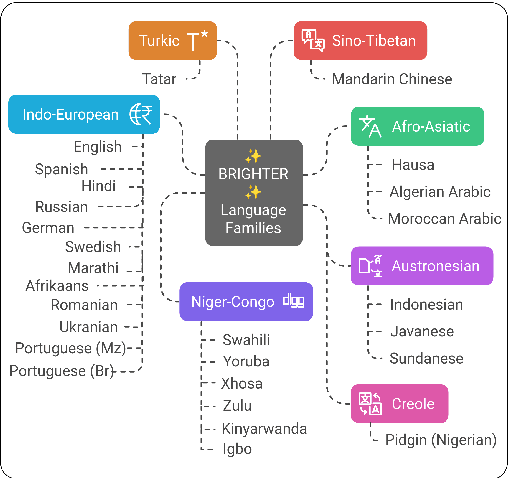
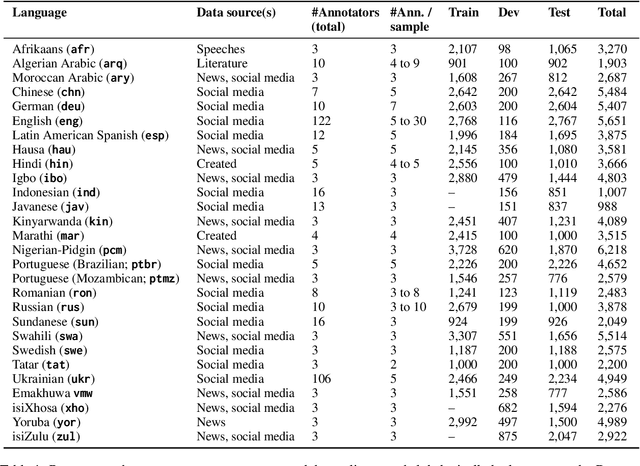
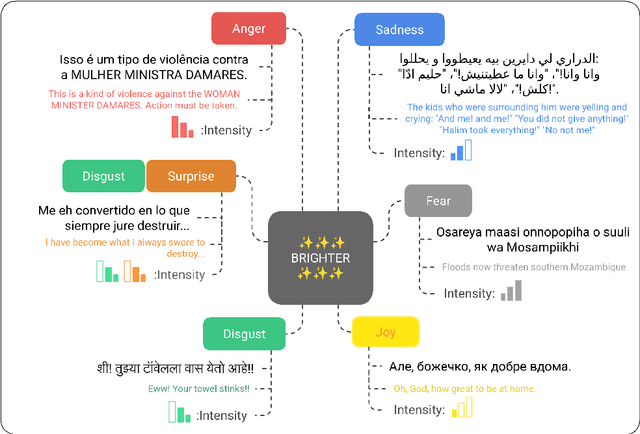
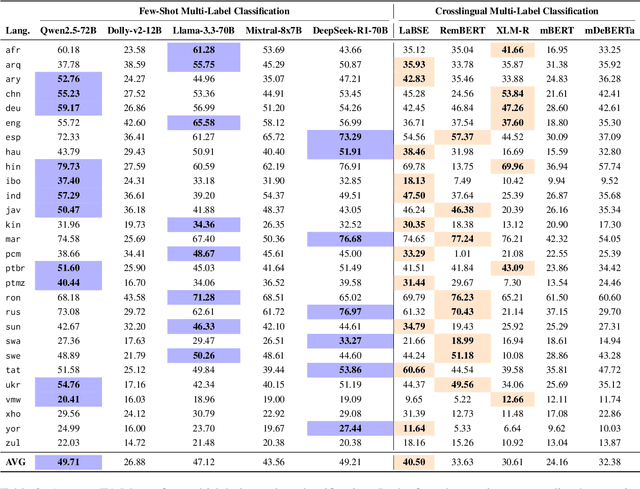
People worldwide use language in subtle and complex ways to express emotions. While emotion recognition -- an umbrella term for several NLP tasks -- significantly impacts different applications in NLP and other fields, most work in the area is focused on high-resource languages. Therefore, this has led to major disparities in research and proposed solutions, especially for low-resource languages that suffer from the lack of high-quality datasets. In this paper, we present BRIGHTER-- a collection of multilabeled emotion-annotated datasets in 28 different languages. BRIGHTER covers predominantly low-resource languages from Africa, Asia, Eastern Europe, and Latin America, with instances from various domains annotated by fluent speakers. We describe the data collection and annotation processes and the challenges of building these datasets. Then, we report different experimental results for monolingual and crosslingual multi-label emotion identification, as well as intensity-level emotion recognition. We investigate results with and without using LLMs and analyse the large variability in performance across languages and text domains. We show that BRIGHTER datasets are a step towards bridging the gap in text-based emotion recognition and discuss their impact and utility.